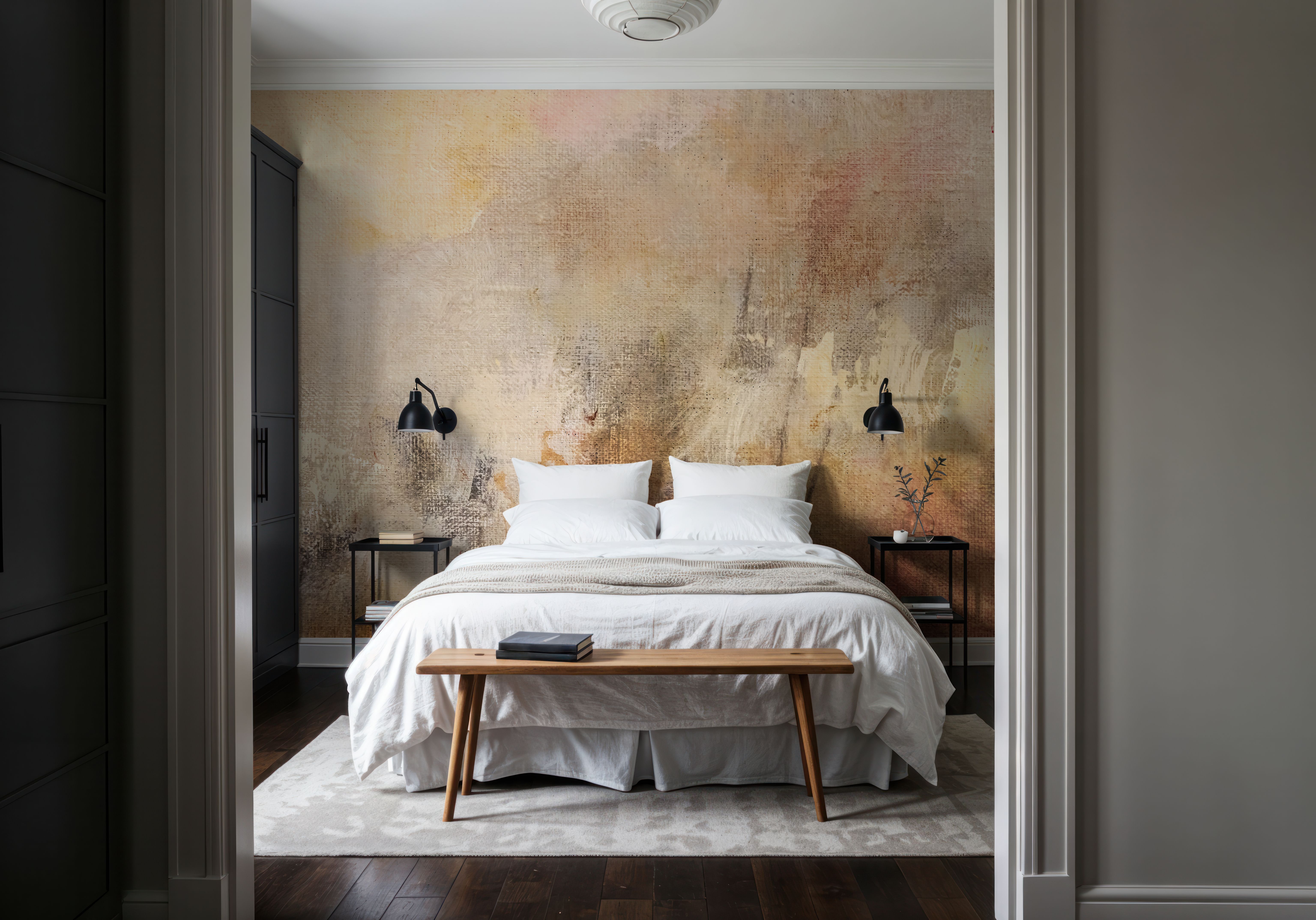
Non-woven is one of the most widely used wallpaper materials today, and every Wallism wallpaper is printed on it. It hangs more easily than traditional paper, it is more breathable than vinyl and, on a primed wall, it comes off far more cleanly than most papers. Here is what non-woven actually is, how it compares with the alternatives and when another material makes more sense.
What non-woven is
Non-woven wallpaper is made from a blend of cellulose and synthetic fibers. The fibers are bonded rather than woven, which is where the name comes from. The important property is stability. Traditional paper swells when it gets wet and shrinks again as it dries, which is why its seams can open. Non-woven stays the same size when it is pasted, so the joins stay where you put them.
Our wallpapers use an uncoated non-woven paper with a premium matte finish. The surface has a slightly fibrous, paper-like feel, and it does not have the plastic sheen of vinyl.
Non-woven or traditional paper
The biggest difference is how they go up. Traditional paper is pasted on the back, folded and left to soak for several minutes before you hang it, and it is fragile while wet. Non-woven is hung dry with the paste-the-wall method. You roll paste onto the wall, place the strip, smooth it and move on. Because the strip is dry, you can nudge it sideways to line up the pattern while the paste is still wet.
The difference shows again when you redecorate. Traditional paper usually needs soaking or steaming to come off, and it tends to tear into small pieces. Most non-woven papers come off in whole strips, provided the wall was primed before hanging. On our papers, a wallpaper primer underneath makes it much easier to remove the strips in full with hot water and a sponge.
Non-woven or vinyl
Vinyl wallpaper has a plastic surface layer, and it is generally the most durable, washable and moisture-resistant common type. That is why it is often chosen for kitchens, bathrooms and hallways. The trade-off is a shinier, more synthetic look, and the plastic surface makes vinyl less breathable.
Non-woven is the more natural-looking and more breathable choice. All our wallpapers are PVC-free, contain no detectable VOCs and are tested for harmful substances. They are still highly washable. A damp cloth handles everyday marks, and for stains you can use mild soapy water, as long as you keep water out of the seams.
If a wall will be scrubbed every week or splashed every day, vinyl or tiles are the better choice. For almost every other wall, including a well-ventilated bathroom away from the shower, non-woven does the job.
Non-woven, Peel & Stick and textured papers
All three of our papers start from non-woven. Premium is our classic paste-the-wall paper. Premium Textured is slightly heavier, with a lightly textured surface. Peel & Stick uses the same non-woven paper with a self-adhesive backing, so it goes straight onto the wall and comes off again when you move.
Peel & Stick is the easy option for renters, but it needs a smooth wall and is not meant for textured walls, ceilings or bathrooms. For a ceiling, a wall with some texture or a wall you want to keep for years, choose Premium or Premium Textured, and check our guide to textured walls first, since a rough surface may need a skim coat.
Hanging and living with non-woven
Let the rolls rest in the room for 24 hours before you start, so the paper adjusts to the humidity. The wall should be clean, smooth, firm and dry. Our strips arrive numbered, 19.3 inches, or 49 cm, wide, and are hung edge to edge without overlapping. Wipe away any paste on the surface as you go, and trim the top and bottom with a sharp knife once everything is up.
Once it is up, non-woven needs very little. The colors are rated 6 to 8 for lightfastness on a scale where 8 is the highest, so they hold up in a sunny room. And for fire safety, our non-woven wallpaper is classified B-s1,d0 under the European standard EN 13501-1 and rated Class A under the American standard ASTM E84.